5G (or fifth generation) cellular is the newest version of mobile internet. As the next step after the 4G LTE that many phones currently use, 5G has the potential to make your phone's internet up to 10 times faster, while also making your connection more reliable.
Major carriers like AT&T, T-Mobile, and Verizon have built large 5G networks across the country. While most of the fastest high-band speeds are located in urban areas, suburbs and rural areas are beginning to see 5G expansion too through mid-band and low-band coverage.
We’ll cover how 5G technology works, which cell phone carriers have the best 5G coverage, and whether it’s worth it to purchase a phone with 5G compatibility.
What is 5G technology?
5G is the fifth generation of cellular network technology. It's currently the fastest network type and offers the lowest latency, but it's also the smallest network for most carriers.
When fully operational, experts estimate that 5G speeds could theoretically top 10-20Gbps. Right now, the average 5G download speed is around 250Mbps since many areas of service are forced to rely on slower network radio bands to offer wider coverage.
Best 5G plans
Virtually every carrier offers a 5G network these days. While you can pick a plan from a major carrier, you can save money by selecting a 5G plan from a smaller carrier like Mint Mobile, Visible, or US Mobile. These smaller carriers—called MVNOs—offer discounted service on the 5G networks from T-Mobile, Verizon, and AT&T. Here are some of the best 5G plans:
|
Mint Mobile

Unlimited Data Plan
$15.00/mo
$45 for 3 months of service
|
|
Visible

$25 Visible Plan
$25.00/mo
Taxes & Fees included
|
|
XFINITY Mobile

Mobile Select Plan
$0.00/mo
(for the first year of service) <br>Regular rate of $30/mo. thereafter
|
|
US Mobile

Unlimited Starter Plan
$25.00/mo
|
|
Tello

Unlimited Text, Talk, and Data Plan
$25.00/mo
|
Benefits of 5G technology
5G technology can be used for more than just your phone service. Major carriers have begun relying on their 5G networks to provide 5G home internet service. This means that customers can now access extremely fast internet speeds without needing a wired connection, like fiber or cable. All a customer needs is a router and a data plan.
In the future, companies hope to deploy 5G in technologies like self-driving vehicles or AI (artificial intelligence). Giving these kinds of technologies access to a wireless high-speed internet connection will increase their efficiency and allow them to complete tasks faster.
How 5G technology works
5G uses a few technologies that differentiate it from older generations of mobile communication.
Dynamic System Sharing (DSS) allows 4G and 5G networks to exist on the same spectrum band. Where 2G, 3G, and 4G were all completely incompatible with each other and had to fill different frequencies, DSS makes it possible to update existing 4G cell towers with 5G technology. This gives the cell phone provider flexibility to switch between 4G and 5G signals within the same frequency band.
Verizon, in particular, has taken advantage of DSS to scale out its low-band 5G by adding 5G tech to its 4G towers.
Massive MIMO (multiple input, multiple output) allows 5G to deliver large amounts of data quickly. Massive MIMO technology uses a high number of antennas to send and receive data from multiple signals all at the same time over the same channel. So instead of clogging up the channel with a single signal, the information transfer becomes much more efficient.
Beamforming helps data travel in the most effective way possible. Instead of sending signals in all directions, it uses antenna arrays to direct the signal to the most efficient route back to the user. This approach cleans up signal interference and improves overall speed.
Is 5G safe?
Yes, 5G is safe. Despite concerns that 5G might cause cancer through radiation, high-frequency millimeter waves are completely safe for humans. The waves are too low on the electromagnetic spectrum to cause cancer or any other harm.
Types of 5G
5G works on a much broader range of frequencies than any previous generation of cellular technology. Think of frequencies like the roads that carry data signals to and from your phone: different frequencies have different speeds and levels of traffic, just like slow country roads, congested city streets, or wide-open highways all impact how fast you can travel.
There are three types of 5G frequencies that cellular networks can use: high-band (millimeter wave or mmWave), mid-band, and low band. These bands determine whether you see blazing-fast new speeds or a barely noticeable improvement over 4G.
Types of 5G cellular technology
| 5G type | Frequency range | Signal distance | Current download speeds | Obstacle penetration |
|---|---|---|---|---|
| High-band (mmWave) | 20-100 GHz | <1,500 ft. | Up to 2.5Gbps | Low |
| Mid-band | 2-10 GHz | Several miles | Up to 1Gbps | Medium |
| Low-band | Under 5 GHz | 100+ miles | Up to 250Mbps | High |
High-band 5G: Best speeds, small coverage area
When we talk about the game-changing potential of 5G, we’re talking about high-band. High-band, or millimeter wave, 5G uses high frequencies (over 20 GHz) that mobile communication hasn’t used before.
There are a few major advantages to mmWave 5G:
- Faster speeds. mmWave 5G can quickly transfer large amounts of data, anywhere from 10 to 100 times faster than 4G LTE. That means downloading a movie to your phone in seconds instead of minutes—no more timing out when you frantically attempt to download a movie in line at the airport.
- Higher bandwidth. Bandwidth refers to the space you have available to transfer data back and forth. Going back to the idea of frequencies as roads, millimeter-wave 5G opens up an entire set of wide-open, super-fast highways that are free from the congestion the lower frequency bands experience.
- Lower latency. Latency is the delay between when you send a signal from your phone to when it arrives at the other end. For example, high latency creates that awkward lag in video calls when one person speaks and it takes a second for the person on the other end to hear them. 5G can drop latency from 200 milliseconds (ms) to 1 ms, making data sharing essentially instantaneous.
Unfortunately, these benefits don’t come without some major hurdles to immediate, widespread access:
- Short signal distance. Millimeter-wave 5G sputters out around 1,500 feet, which means cell providers have to install a lot of access points to create a reliable 5G network.<
- Difficulty moving through objects. High-band 5G doesn’t travel well through obstacles. Walls, windows, and trees will limit how far the signal can go.
Instead of building a traditional cell tower every thousand feet, high-band 5G uses small cells, which are much smaller base stations of equipment. About the size of a backpack, a small cell can be attached to a telephone pole, a street light, or the side of a building. But even with the relative ease of installation, the sheer number of small cells it takes to create consistent high-band coverage creates a barrier to entry in the short term.
Access to high band 5G in the U.S. is extremely limited. Verizon leads the charge on high-band mmWave 5G (what it calls “Ultra-Wideband”), though its network has since expanded to include low-band 5G (which it has dubbed "5G Nationwide"). AT&T also offers high-band hotspots in select cities.
Mid-band 5G: Great middle option, limited in U.S.
Mid-band 5G strikes a nice balance between distance and speed. The speed ceiling isn’t quite as high as it is for high-band 5G, but maxing out at 1Gbps download speed still blows 4G speeds out of the water. For day-to-day use, it’s more than fast enough to load web pages instantly or stream in 4K without buffering.
Mid-band frequencies can also cover several miles, and they move through objects more easily than millimeter-wave frequencies do. Many countries across Europe and Asia have chosen to exclusively use mid-band 5G as the sweet spot for practical rollout and faster speeds. So why doesn’t the U.S.?
To put it bluntly, our mid-band spectrum is already full. It’s a traffic jam of 4G and other technologies hogging all of the frequency bands, so there isn’t much space left over for 5G. That said, T-Mobile has expanded its mid-band spectrum and, as a result, has achieved the fastest and most robust 5G network nationwide.
Low-band 5G: Broad availability, lower speeds
Low-band 5G uses the lowest frequencies to transfer data, which makes it the slowest type of 5G by a long shot. According to a T-Mobile rep, customers using low-band 5G should see about a 20% bump in speed over 4G LTE.
Despite the comparatively slower speeds, low-band 5G has some advantages that make it attractive. These lower frequencies can travel hundreds of miles, and they also travel through obstacles more easily than either high-band or mid-band.
Because low-band is the fastest and easiest way to build a broad 5G base, T-Mobile, AT&T, and Verizon all offer low-band coverage. So when you hear providers advertising “nationwide 5G,” it almost always means the slower low-band speeds.
5G availability and coverage
T-Mobile, AT&T, and Verizon all have 5G networks, but the type of 5G varies from provider to provider.
T-Mobile 5G coverage
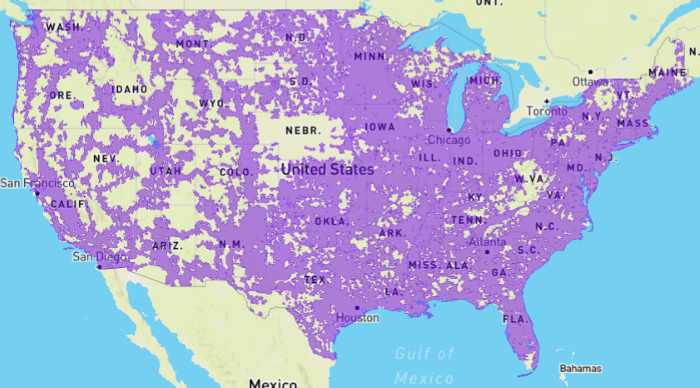
Image: Max McCaskill
T-Mobile has the most 5G service in the U.S., at 53.79%. Almost all of this coverage is low-band (600 MHz) 5G, though T-Mobile also has mid-band and high-band 5G coverage called its 5G UC (ultra capacity) network. Check out T-Mobile’s 5G coverage map to see if you're covered.
AT&T 5G coverage

Image: Max McCaskill
AT&T has more limited low-band coverage in the U.S., but still comes in second place with 29.52% nationwide coverage. AT&T has very limited high-band coverage (called 5G+) and a little mid-band coverage. Check AT&T’s 5G coverage map to see if your area has coverage.
Verizon 5G coverage

Image: Max McCaskill
Verizon has the most high-band 5G access in the U.S. The carrier calls its high-band coverage the 5G UW (ultra-wideband) network, but it's still limited to select urban areas. The company also rolled out low-band 5G, bringing its total 5G coverage to about 12.77% of the U.S. Check Verizon’s 5G coverage map for more details.
How fast is 5G?
In theory, 5G could reach up to 10Gbps download speeds—100 times faster than 4G, which caps out around 100Mbps (at best). But actual 5G speeds depend heavily on the type of 5G you have. Low-band 5G speeds are comparable to or slightly faster than 4G, while mid-band speeds can reach 1Gbps, and high-band 5G can go as high as 2.5–3Gbps.
So what does that mean for real-life activities? Let’s compare what it would look like to get high-band 3Gbps speeds with 5G compared to 100Mbps with 4G LTE.
4G. vs. 5G download comparison
| Download Activity | 4G LTE download time (at 100Mbps) | 5G download time (at 3Gbps) |
|---|---|---|
| 3GB HD movie | 4 min. | 8 sec. |
| 100GB 4K movie | 2 hr. 13 min. | 4 min. 26 sec. |
| 50GB game | 1 hr. 6 min. | 2 min. 13 sec. |
| 3.5 MB song | <1 sec. | <1 sec. |
| 100 MB app | 8 sec. | <1 sec. |
| 5-min. YouTube video (30MB/480p) | 40 min. | 80 sec. |
What is 5G: FAQs
Do I need to buy a new phone to get 5G?
If your device is over five years old, you probably need a new phone to get 5G coverage. Luckily, virtually all of the newest devices have 5G technology built into them, including the Apple iPhone 16, Samsung Galaxy S25, and Google Pixel 9.
Keep in mind that a 5G device is only as good as the network it uses. If 5G is your primary motivator for buying a new device, you’ll want to check 5G coverage in your area before you make the switch.
What do cell phone generations mean?
The "G" in 5G stands for generation. Each cell phone generation represents a new tech advancement that has clearly defined performance standards and provides a significant jump forward in user experience. The first generation, 1G, was limited to analog voice calls. 2G allowed for more data transfer, including text and image messages. 3G opened up mobile internet, and 4G increased speeds, allowing for video streaming and video calls. 5G is the latest jump forward, with the ability to transfer much more data more quickly.
How do I get 5G on my phone?
To enjoy 5G on your phone, you’ll need a 5G-capable mobile device along with a plan that supports 5G speeds. Additionally, you’ll require an actual 5G signal, so check carrier coverage maps to find out who offers the best service in your area.
Is LTE 5G?
No, LTE is not 5G. Instead, 5G is the next iteration of mobile wireless communications, with the G standing for generation. 4G LTE, or 4G Long Term Evolution, uses a different spectrum than 5G. That said, your phone can use both spectrums. If your device's battery is low, you may save power by temporarily turning off 5G and using 4G LTE instead.
What is 6G and when will it be available?
As the name implies, 6G will be the sixth generation of modern wireless technology. Every new generation of wireless technology brings about new and more advanced ways of digital encoding.
Unfortunately, we won’t see 6G technology until semiconductor materials capable of THz frequencies are invented—probably around 2030.
Lauren Hannula
Managing Editor

Find a better phone plan
Thousands of cell phone plans unpacked. All the facts. No surprises.


.png?w=280&h=280&usm=20&usmrad=0.8&fit=crop "Best Cell Phone Deals for July 2026: Get the New iPhone 17 for Free")