Cell service drops at music festivals because thousands of devices are trying to connect to the same cell towers at the same time and exceeding the towers' capacity. This issue is called network congestion, and it occurs regardless of how strong your signal appears.
Your phone might show full bars at a festival but won't load a webpage or send a text because too many people are using the same bandwidth. Read on to learn exactly why this happens and how to make sure you stay connected at your next festival.
Network Congestion at music festivals explained
Every time you use your phone outside, it connects wirelessly to a nearby cell tower so you can receive calls, texts, and data. The connection travels over radio frequency bands that carry a fixed amount of data or information at any given time. Each tower manages multiple bands, but each band has a limit on how much data it can process (called bandwidth).
Cell service at a music festival is like the waterline through an eight-story building. Under normal conditions, it pushes water up through the pipes to every floor without a drop in pressure. However, if every resident on every floor turns on every faucet and every shower at the exact same moment, it cannot push enough water all at once. At a festival, your phone is one of countless devices all demanding a signal from that same cell tower simultaneously, but there isn't enough bandwidth to go around.
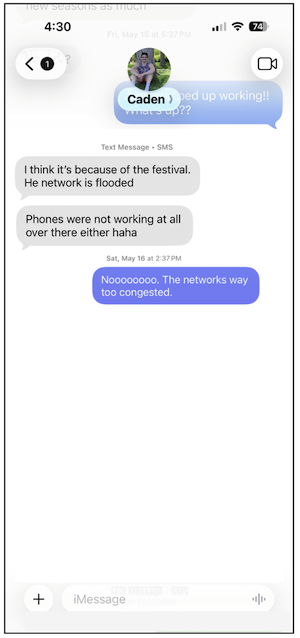
Image: Daphne Kelly| WhistleOut
WhistleOut phone expert Daphne Kelly ran into this problem trying to contact a friend of hers at Kilby Block Party in downtown Salt Lake City. No matter how much she tried, calls dropped and texts never sent.
Despite having full service, it was impossible for Daphne to make contact — and this happens frequently. So much so that many wireless carriers bring in extra signal reinforcement to major events. Some carriers use temporary cell infrastructure (Cells on Wheels) or portable antenna systems. But temporary infrastructure has limits, and it doesn't scale to the full size of every event.
Best apps for music festivals
- Google Maps is the best option for getting around with offline navigation that works without a signal. Download your festival region the night before, and you can navigate without any data connection at all.
- Life360 keeps you safe with real-time location sharing for your whole group. When texts won't send and calls won't connect, your group can still see exactly where everyone is on a shared live map.
- WhatsApp works well for group messaging with easy-to-use voice messaging. WhatsApp uses cellular data rather than the cellular network, so it keeps working even when your standard messaging app won't.
How to get better cell service at a festival
You can't control the tower infrastructure, but you can take steps that improve your odds of staying connected when the network is busy. Follow these music festival cell phone tips for a better signal at your next concert:
- Move away from the stage area. The densest concentration of devices is always at the front, near the stage. Walking toward the outer perimeter of the festival grounds (where fewer devices are competing for the same signal) will give you a better chance of getting a message through.
- Toggle airplane mode on and off. Switching to airplane mode for a few seconds and then turning it back off forces your phone to restart its connection process, which can help it find a less congested channel.
- Connect to festival Wi-Fi. Festival grounds often have Wi-Fi hotspots near food vendors and entry gates for a better connection than the overloaded cell towers.
- Send a text instead of making a call. A short SMS text can squeeze through a congested network better than a voice call. When you need to coordinate with your group, a text message will get through before a phone call will.
- Use WhatsApp voice messages instead of standard calls. WhatsApp voice messages transmit as data packets rather than being routed through the cellular voice network.
If you see SOS instead of signal bars on your phone and aren't sure what that means, check out WhistleOut's guide on SOS settings on your phone.
Top tips to save battery
When your phone constantly searches for a signal on a congested network, the battery drains at double the normal rate. Follow these steps to help your battery last through the full day:
- Bring a power bank. For a multi-day festival, a compact 10,000mAh bank fits easily in a small bag and provides at least one full recharge when you need it most. I always take my Anker power bank with me.
- Use airplane mode whenever possible. Once your group is together and you don't need to communicate, switching on airplane mode stops your phone from searching for a signal and slows battery drain.
- Lower your screen brightness. Pulling your display's light down makes a huge difference over a long festival day.
- Enable Low Power Mode early. Don't wait until you're at 10% battery to turn on Low Power Mode. This will stretch your charge further throughout the afternoon and evening sets.
Which carrier has the best coverage for music festivals?
AT&T has the best coverage, according to Reddit and my own personal experience, for festival goers. Technically, all three major U.S. carriers (AT&T, T-Mobile, and Verizon) have solid coverage at every major festival on their maps. The real question isn't who covers the location; it's who has the best capacity. AT&T's low-band spectrum gives the signal strong range and resilience under congestion.
Get AT&T for the festival season
AT&T is the carrier most likely to keep you connected when thousands of other devices are competing for a signal.
Check out the best AT&T unlimited plans available now:
|
AT&T

Premium 2.0℠
$90.00/mo
+ $35 Upfront
|
|
AT&T
Extra 2.0℠
$70.00/mo
+ $35 Upfront
|
|
AT&T
Value 2.0℠
$50.00/mo
+ $35 Upfront
|
T-Mobile and Verizon don't offer a balanced mix of bands like AT&T. T-Mobile uses mostly mid-band 5G frequencies, which saturate faster than low-band when demand spikes sharply. Plus, the signal can't travel far enough or penetrate a crowd to reach most attendees. On the other end of the spectrum, Verizon's signal travels almost exclusively on lower-band frequencies, which are already slow. Congestion just makes them even slower.
Read all about how AT&T, T-Mobile, and Verizon networks compare with side-by-side results.
A quick guide to frequency bands
Not all cell signals travel the same way, and the difference matters at a festival. Carriers transmit data across three main types of frequency bands, each balancing speed and range differently.
- Low-band (below 1GHz): Low-band carries both 4G and 5G signals and travels the farthest of any band type. At a congested festival, it is often the only band still delivering any usable connection to most attendees.
- Mid-band (1–6GHz): Mid-band is where both 4G LTE and the majority of 5G traffic pass under normal conditions. It balances speed and coverage well, but it saturates quickly when tons of devices compete for the same slice of spectrum at once.
- High-band or mmWave (24GHz and above): mmWave is a 5G-only band that delivers the fastest speeds, but the signal can barely pass through a wall, let alone a crowd. Unless you are standing next to a temporary antenna, you won't benefit from it at an outdoor event.
At a festival, low-band (or 4G) determines whether you have any connection at all, mid-band determines whether that connection is usable, and mmWave is largely irrelevant. Read more in our guide to 5G network types and bands.
Festival cell signal: FAQ
Why is cell service so bad at music festivals?
Cell service is usually poor at music festivals because thousands of devices are connected to the same networks, overwhelming the capacity of local cell towers. Your phone may show full signal bars because it is connected to the tower, but the tower cannot process all the requests it is receiving at once.
Which phone carrier is best for music festivals?
According to Redditors, AT&T is the best carrier for music festivals because it offers a mix of 4G and 5G bands to handle more capacity.
How do I get a cell phone signal at a festival?
Moving away from the stage area will improve your signal. You can also toggle airplane mode off to force your phone to search for a fresh connection.
Should I download maps and schedules before going to a festival?
Yes, and you should download Google Maps the night before. Make sure you have your necessary offline map, save your set schedule as a screenshot, and store important contacts in your Notes app.
Jessica Santero
Staff Writer

Find a better phone plan
Thousands of cell phone plans unpacked. All the facts. No surprises.