If you've been a UScellular customer for any length of time, you've probably noticed something feels different lately. Maybe you got a notice in the mail, or saw a headline, or even just searched "does UScellular still exist" and ended up here.
If you're in this situation, here's what's happened: UScellular, as you knew it, is now part of T-Mobile.
T-Mobile completed its $4.3 billion acquisition of UScellular's wireless operations on August 1, 2025. That means over four million UScellular customers are now in the process of transitioning to T-Mobile, including a large part of the network, the stores, and eventually the brand itself.
This guide covers what T-Mobile actually acquired, what happened to UScellular's coverage map, and what you should do if you're an existing customer trying to figure out your next move.
T-Mobile/UScellular deal: What did T-Mobile acquire?
T-Mobile didn't buy all of UScellular. The deal, which was announced in May 2024 and closed on August 1, 2025, included buying three specific things:
- UScellular's wireless customers
- UScellular's retail store locations
- Approximately 30% of UScellular's wireless spectrum portfolio.
What T-Mobile didn't get was the towers. UScellular's parent company held onto its physical tower infrastructure, which now operates under a new entity called Array Digital Infrastructure Inc. T-Mobile is leasing access to some of those towers as part of the deal.
What T-Mobile did get was the radio frequency licenses that UScellular used to power its network. More of those licenses means more capacity, which translates directly to better coverage and faster speeds, especially in the rural areas where UScellular was strongest.
For UScellular customers, the transition means you're now officially in T-Mobile's ecosystem. Your plan and service continue as normal for the time being, but your account will eventually be migrated to T-Mobile's systems. More on what that means below.
Why does this matter for rural coverage?
UScellular built its whole identity around strong rural coverage in places like Iowa, Wisconsin, and Nebraska, specifically the markets where Verizon, AT&T, and T-Mobile had historically been thin.
By absorbing UScellular's radio licenses and customer base, T-Mobile significantly strengthened its position in the markets where UScellular thrived. T-Mobile was already the leader in rural 5G coverage before this deal, and folding in UScellular's frequencies only extends that lead.
UScellular coverage map

Image Credit: WhistleOut
Click on the coverage map to activate it and toggle between each of UScellular's 3G, 4G LTE, and 5G networks.
UScellular 4G LTE coverage
While UScellular's 4G LTE network was the largest part of its footprint, it only covered roughly 10% of the U.S. overall. Now with T-Mobile, that number jumps to over 62% of the country, giving a lot more network coverage to UScellular customers.
Plus, T-Mobile customers also benefit from expanded rural coverage because of the acquisition.
UScellular 5G coverage
5G on UScellular's native network was always sparse compared to the big three. Iowa and Wisconsin had the densest 5G footprint; Nebraska, Illinois, and Missouri were spottier. And everywhere else had little to no 5G coverage at all.
However, with T-Mobile's integration of the two networks, UScellular customers can now access the largest 5G network in the country. That means nationwide 5G coverage, a massive step up from UScellular's original footprint.

T-Mobile's coverage brings a large upgrade to what UScellular offered.
Image Credit: WhistleOut
If you were a UScellular customer and worried about losing signal in areas UScellular didn't reach, that concern is largely off the table now.
UScellular coverage vs. Verizon, AT&T, and T-Mobile
Now, to understand the UScellular upgrade, let’s stack UScellular’s coverage against what it gains from T-Mobile's coverage compared to Verizon's and AT&T's. Here’s a percentage breakdown of how much of the country each Big Three network covers compared to what UScellular had:
- Verizon: 70% 4G LTE coverage
- AT&T: 68% 4G LTE coverage
- T-Mobile: 62% 4G LTE coverage
- UScellular: 10.27% 4G LTE coverage
It's a pretty massive drop-off from the other major networks. But where Verizon, AT&T, and T-Mobile try to cover everybody, UScellular specialized in offering really reliable coverage in specific parts of the country. And now that T-Mobile owns UScellular's customers, those markets get both the deep local coverage UScellular built and T-Mobile's nationwide network behind it.
If you live in any of the states below, you're in UScellular's core territory:
- Iowa
- Wisconsin
- Nebraska
- Oklahoma
- Arkansas
- Illinois
- Kansas
- Washington
- Oregon
- Missouri
- Northern California
- North Carolina
- Tennessee
- Virginia
- West Virginia
- Maryland
- New Hampshire
- Maine
If you don't live in any of these states, UScellular probably wasn't the right fit anyway. If you do, the T-Mobile acquisition is good news for your coverage going forward.
Is UScellular coverage good?
In its core markets, yes. In most of the country, no.
UScellular was built specifically to serve rural America, and it did that well. The areas it covered, it covered with a depth that the big three couldn't match. The trade-off was that it covered a small slice of the map.
Now that the T-Mobile acquisition is complete, that calculus is starting to shift. Customers in UScellular's traditional markets now access T-Mobile's nationwide network, which means better coverage when they travel outside of UScellular's original footprint.
Using other networks with UScellular
One thing worth understanding: UScellular's own coverage map always looked bigger than it actually was because it included roaming agreements with AT&T and T-Mobile. Where UScellular's native network didn't reach, your phone would switch over to a partner network automatically.
Roaming worked, but it came with slower speeds and less reliable performance. The T-Mobile integration changes this because instead of roaming onto T-Mobile's network, UScellular customers can run natively on it, which is a big upgrade.
Does UScellular have good coverage near you?
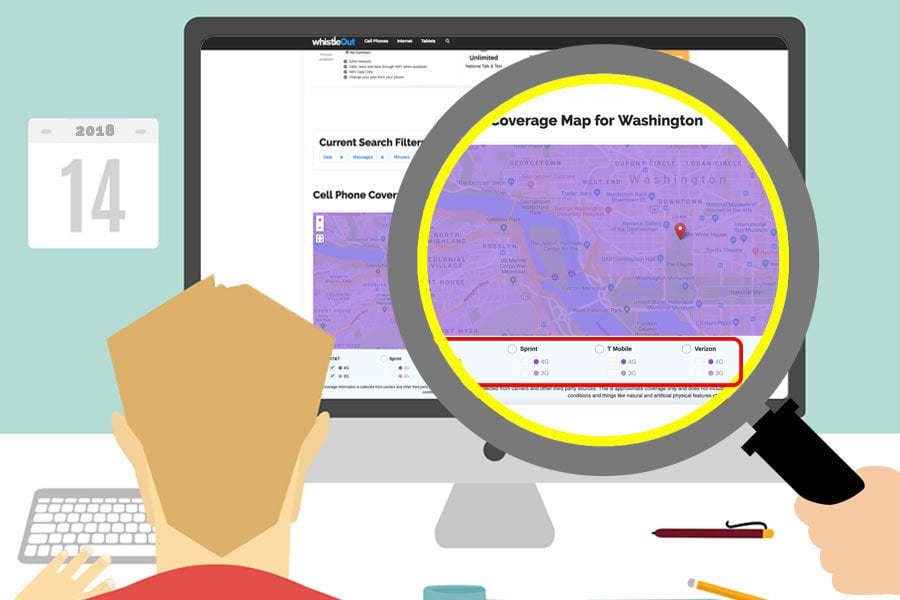
There are two ways to check UScellular's coverage near you. Check out the coverage near you through our interactive map above, or follow our instructions to check through our phone comparison engine.
The best way to check UScellular's signal near you is through WhistleOut's interactive map. Toggle between LTE and 5G networks on our interactive map to determine if your area has a strong UScellular signal. If your area is saturated in purple, you can expect reliable service from UScellular.
If you want to check coverage for a specific UScellular plan, head over to our comparison engine tool. Simply adjust your talk/text/data preferences, then type your street address where it reads "Coverage Check." On the resulting page, you'll be able to get location-specific UScellular coverage map info by clicking one of the buttons on the upper-right-hand of your screen.
Check out which UScellular phone plans we like best and what our review of UScellular looks like.
You can also check out UScellular's coverage in your neighborhood by using our phone plan comparison engine. Simply click on the blue letters that say “Change Location.”

This is where you can find the button.
Enter your address to see all the wireless carriers that provide coverage in your area. You can fine-tune your results depending on whatever data, minutes, and texts you want for your cell phone plan.


If you see UScellular in your results, then you do indeed have coverage in your area! If you don’t, well, don’t be sad. There are plenty of other affordable wireless carriers to pick from.
UScellular cell phone plans
UScellular is no longer signing up new customers. As of the acquisition, the ability to add new lines or select new UScellular plans has been paused while accounts migrate to T-Mobile's systems.
Existing UScellular customers stay on their current plans for now, and no changes are being forced immediately. But as the migration completes, those customers will have the option to move to one of T-Mobile's unlimited plans, which come with perks that UScellular's plans never offered: streaming benefits like Netflix and Apple TV+, free international roaming in over 215 countries, free in-flight Wi-Fi, and device upgrade programs.
Here's a look at what T-Mobile has to offer once your account moves over:

T-Mobile is the obvious next step for most UScellular customers—but obvious doesn't always mean best value. MVNOs like Mint Mobile and Visible Wireless can run on the same major networks as the Big Three at a fraction of the price. It's worth comparing plans before you commit.


Switching to T-Mobile
If you're an existing UScellular customer, you don't have to do anything right now. Your service continues as normal, and T-Mobile will contact you with the next steps when your account is ready to move.
If you'd rather get ahead of it and switch to T-Mobile now, you can do that. Switching early gives you access to T-Mobile's current device promotions and plan options without waiting for the migration timeline. You can port your existing number over, and nearly all UScellular devices are compatible with T-Mobile's network.
If you're not sure if T-Mobile is the right call, stop to shop around. Check out our best cell phone plans guide to see how T-Mobile stacks up against the competition, or browse affordable wireless options if you're looking to cut your bill while you're at it.
UScellular coverage: FAQ
Will my UScellular coverage change now that T-Mobile bought UScellular?
Your UScellular coverage will change, and it should get better. Your existing coverage isn't being downgraded. What's changing is that parts of UScellular's native network are being integrated into T-Mobile's, which means you'll eventually have access to T-Mobile's full nationwide 5G footprint instead of UScellular's regional one. The areas where UScellular's coverage was strongest, like Iowa and Wisconsin, should see coverage improvements as T-Mobile adds UScellular's spectrum to its own network.
Does UScellular have good coverage in rural areas?
Rural coverage was always UScellular's main selling point. The carrier built its network specifically for the rural Midwest, covering areas where Verizon, AT&T, and T-Mobile were thin. That native rural strength is now part of T-Mobile's network, which was already the leader in rural 5G before the acquisition. For customers in rural markets, this transition is a net positive.
What's the difference between UScellular's native coverage and roaming coverage?
Native coverage means your phone is running directly on UScellular's own towers. Roaming coverage means your phone has switched to a partner network, usually AT&T or T-Mobile, because UScellular's signal isn't available. Roaming doesn't cost extra on UScellular plans, but it typically results in slower speeds and less reliable performance. As the T-Mobile integration progresses, the distinction becomes less relevant: What was roaming onto T-Mobile's network is now just part of T-Mobile's network natively.
Should I switch from UScellular to T-Mobile now that they're merging?
Existing UScellular customers can stay on their current plans and wait for the account migration to happen on T-Mobile's timeline. If you'd rather get ahead of it, switching to T-Mobile now gets you access to current promotions and plan perks that UScellular plans don't offer. The main reason to switch proactively is if you want a new device or a plan upgrade sooner rather than later, since T-Mobile pauses some account actions, like adding lines, during the migration period.
Is UScellular still accepting new customers?
As of the acquisition, UScellular has paused new plan signups and the ability to add new lines while accounts migrate to T-Mobile. If you were considering UScellular, T-Mobile is now the direct successor for coverage in those same rural markets. Check out our T-Mobile coverage guide and our full UScellular review for more context on how to evaluate your options.
Scott Houghton
Jr. Staff Writer

Thousands of cell phone plans unpacked. All the facts. No surprises.

Related Articles


Related Topics
CoveragePopular Topics
Featured App Reviews iOS News Coverage Device Reviews Device Explainers Carrier Explainers App Roundups T-Mobile